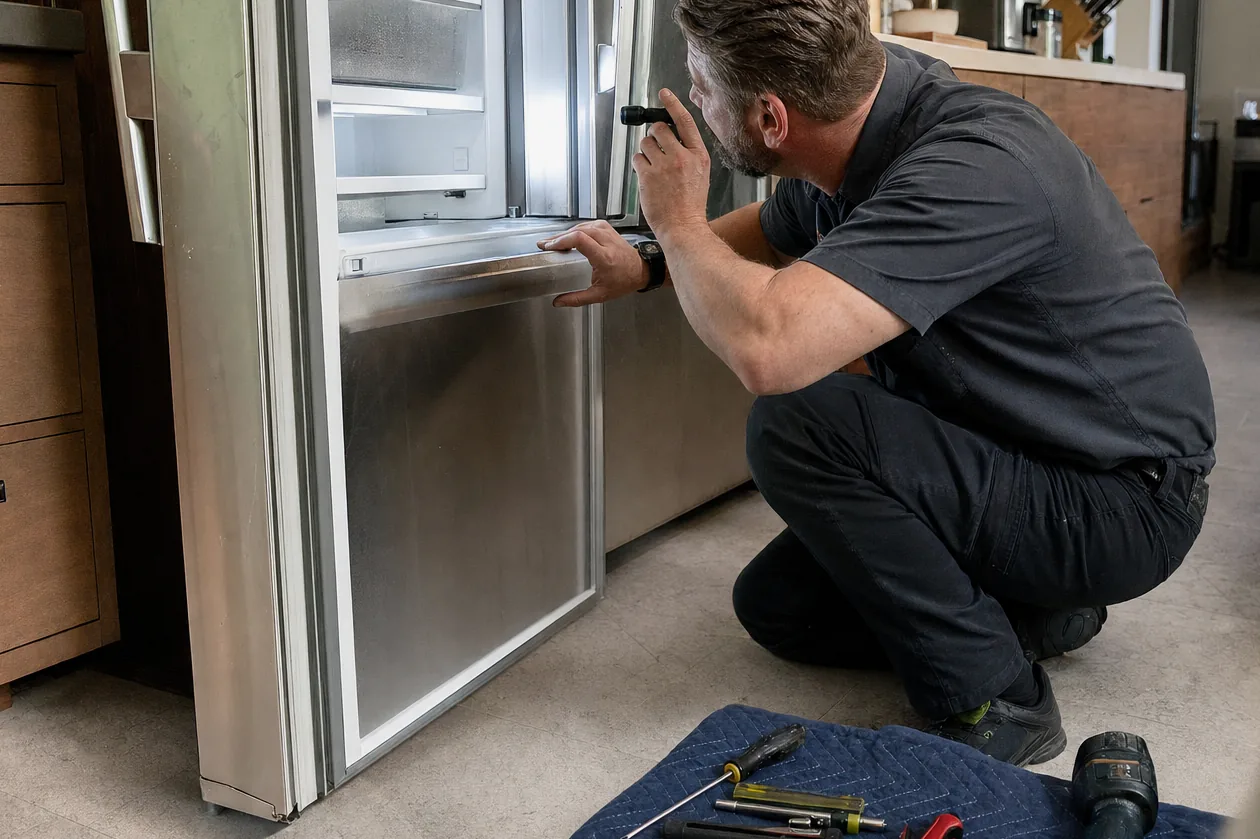
A freestanding refrigerator is a purchase. A built-in is a piece of the kitchen. That difference is the whole of the repair-versus-replace decision, and it is the reason the arithmetic that applies to a mass-market appliance does not apply here.
What replacement actually involves
A built-in is fixed to the surrounding cabinetry. It is set into an opening finished to a tolerance, it frequently carries custom panels made to match the cabinet run, and its grille, trim and rails were fitted to that opening rather than to a generic gap.
So a replacement is rarely just a replacement. It is a delivery, a removal, a disposal, a fitting, and — in an opening that is out of square, or was widened once decades ago, or has a soffit closed in across the top of it — a carpentry job on top. Where the old cabinet’s panels do not transfer, it becomes a millwork job as well. None of that appears on the price tag of the new machine, and all of it appears on the final invoice.
That is why we quote repairs on this equipment that would be absurd on a freestanding unit. The comparison is not repair against a new appliance. It is repair against the whole project.
The conditions that make repair the right answer
The cabinet is straight and the interior is intact. Doors hanging parallel, liner uncracked, shelving and drawer hardware present and working. The expensive, un-replaceable parts of a built-in are the case and the liner, and if those are sound the machine is worth money.
The fault is identified rather than assumed. A named component with a measurement behind it, on a written estimate. “It is probably the board” is not a diagnosis and it is not a basis for spending anything.
It is the first significant repair. A single failure on a fifteen-year-old cabinet is what a fifteen-year-old cabinet does. It is not evidence of a machine in decline.
The part exists. Confirmed against the serial number, with a date, before anyone approves anything.
The three conditions that end it
A sealed-system leak that cannot be reached. Where the leak is in tubing routed through the foam of the case, getting to it means destroying the liner. That is not a repair, and any quote that treats it as one is a quote to open something that will not close again.
A third sealed-system repair. A second one is a judgement call. A third, on the same machine, is a pattern, and we will say so even though saying so costs us the job.
Structural damage to the case or the door. A racked case or a door that has been forced is a fault that follows every subsequent repair around, because nothing seals against it.
What we do about the decision
We charge one diagnostic and give you the facts in writing: what is wrong, what the part costs, what the labor costs, what the part’s lead time actually is, and what condition the rest of the cabinet is in. Then we say what we would do.
Where the answer is replace, we say replace, and we do not have a machine to sell you — which is the only reason the recommendation is worth anything. Where the answer is repair, the estimate carries every measurement that led to it, so you can take the sheet somewhere else and get a second opinion on the same data.
One thing worth doing either way
Find the model and serial plate before you call anyone. On a built-in it sits inside the fresh-food compartment on the upper left side wall.
Built-in refrigeration is produced in long-lived platforms with running changes, and gaskets, boards, fan assemblies and door hardware are frequently specific to a serial range rather than to the model as a whole. A part ordered against the model alone is how a repair loses a week and a homeowner loses confidence in the person who ordered it. Two minutes with a phone camera at the start removes that entire category of problem.