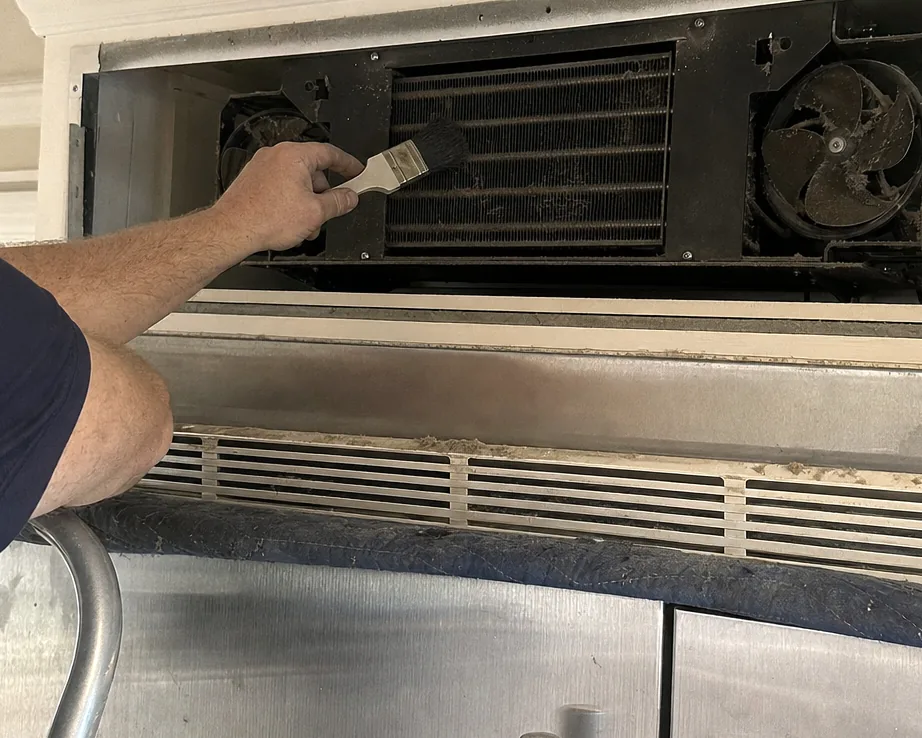
There is a difference between a dirty condenser and a corroded one, and it determines whether a cleaning is worth doing.
A dirty coil has lost airflow. Remove the mat of dust and pollen and it performs as designed again. That is most of Duval, and it is why condenser service twice a year is the highest-value maintenance item on an inland built-in.
A corroded coil has lost metal. The fins have thinned, powdered, and in places detached from the tube. Surface area is gone permanently, and no amount of brushing brings it back. That is what we find within a few blocks of the ocean in 32250 and 32233, and it changes the recommendation from “clean it” to “replace it or plan for the cabinet”.
The mechanism
Aluminum protects itself with an oxide layer. That layer holds up well in dry air and poorly against chloride.
Salt aerosol lands on the fins and stays. It is hygroscopic — it pulls moisture out of humid air and holds a film of salt solution against the metal between rain events, which in a North Florida summer means essentially continuously. The oxide layer is attacked locally, pitting begins, and because the fin stock is thin to start with, it does not take long for a pit to become a hole.
The second mechanism is galvanic. A condenser assembly puts aluminum fins in contact with copper tube and steel fasteners. Add a conductive salt film and you have a cell. The aluminum is the sacrificial half, and it loses.
What we look at on a coastal call
Fin condition under a light. Bright, straight fins with intact edges are fouled at worst. Dull grey fins with a chalky surface, or fins that crumble under a soft brush, are corroded.
The junctions. Fastener heads, the fan shroud mounting, and the bracket where the coil is supported. Corrosion appears at the junctions first because that is where the galvanic cell is.
Where the grille draws from. A cabinet whose intake sits in a covered lanai or a breezeway can be pulling concentrated salt spray. Changing that airflow path is far cheaper than replacing a condenser a second time.
Hinge and closer hardware. The same air works on hinge pins. Play at the pin lets the door hang slightly out of parallel, the gasket loses contact along one edge, and the first complaint is condensation rather than corrosion.
The stainless. Tea-coloured staining on a beach-house door is airborne chloride sitting on the passive layer. It is cosmetic while it is on the flat panel. It stops being cosmetic when it reaches a weld seam or a fastener.
What we recommend, and what we will not claim
Three condenser services a year rather than two within sight of the water, and a hardware inspection every visit. Rinse the grille area with fresh water when the kitchen allows it.
What we will not tell you is that any of this makes a coastal installation last as long as an inland one. It does not. What it does is push a condenser replacement from year eight to somewhere well beyond it, which on a built-in is worth a great deal.
And for an outdoor summer kitchen, the only durable answer is a cabinet rated for outdoor installation in the first place. Where one is not, we will say so rather than book the same repair every year.